Nvidia CUDA‑X libraries cut black‑hole data crunch to minutes
Nvidia announced on 16 November 2026 that its expanded CUDA‑X libraries are giving AI agents the power to slash processing times across astronomy, fusion, drug design and more. Tools like cuPhoton.xBeam now turn a month‑long black‑hole data job into an eight‑minute run.
Black‑hole imaging in minutes
The Event Horizon Telescope gathers petabytes of radio data to image a black hole, a task that historically took months. Nvidia’s cuPhoton.xBeam module speeds that up “orders of magnitude”, reducing a typical analysis from over a month to eight minutes.
The pipeline runs on distributed multi‑GPU clusters or a compact DGX Spark system, letting researchers watch gas spiralling into a black hole almost in real time.
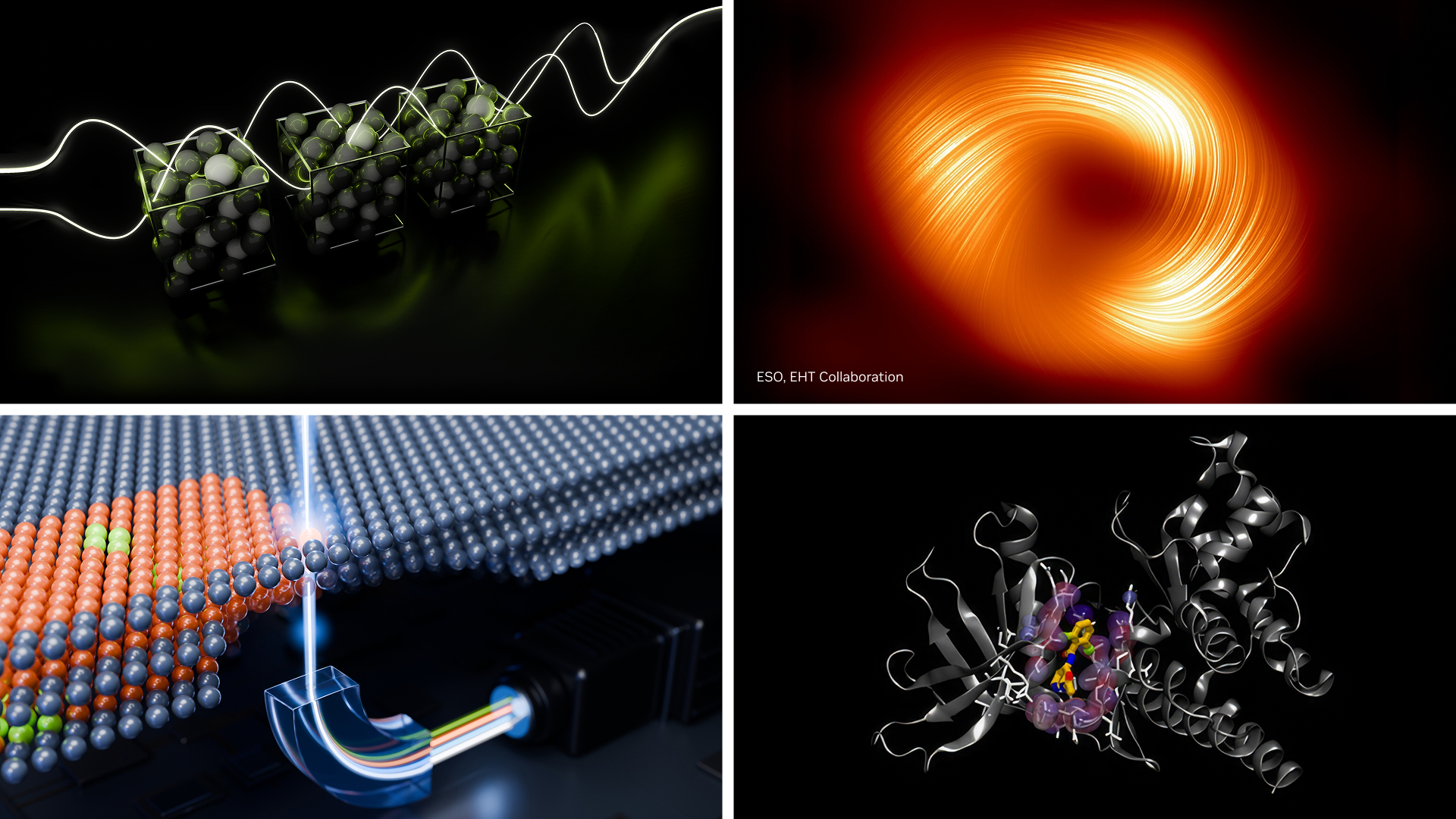
Image: NVIDIA
Fusion simulations get live feedback
Simulating plasma for fusion reactors normally consumes days per time step on petascale machines. Pacific Fusion researchers now use the cuPhoton.xLens module to extract insights while simulations run, feeding a Nemotron‑powered agent that can steer the experiment in real time.
- Interactive analysis during runs
- Guides reactor target and chamber design
Drug discovery sees 3× speedup
Nvidia cuPotential, built with help from the Simons Foundation’s Flatiron Institute and D.E. Shaw Research, accelerates molecular‑dynamics software up to three times while improving stability. Companies such as Cadence, Fathom Therapeutics and Terray Therapeutics are already adopting it.
Materials and biology benefit too
The Daviator kernel set for VASP delivers quantum‑mechanical calculations up to 22× faster at 75 % lower cost. At Lawrence Berkeley National Laboratory, the DAQIRI library links an electron‑microscopy detector straight to the GPU, moving analysis into the experiment.
In biology, the open‑source cuSpa speeds cell‑polygon calculations 900× versus CPUs, and the rapids‑singlecell framework lets Therna Biosciences process data 200× faster.
Sources
This post is based on NVIDIA.
Want more AI news in plain English? Read the latest on the Zoetra Blog.