Google's Gemini 4 Carbon sets new bar for AI cyberdefence
On 28 October 2026 Google announced Gemini 4 Carbon, its newest frontier AI model. The company says the model delivers a “significant leap” in coding, agentic tasks and especially cybersecurity, and it will roll out first to trusted cyber‑defence partners.
Benchmark supremacy
Carbon ranks #1 on the v5.0 Artificial Analysis Intelligence Index with a score of 59. It leads SEC‑bench Pro at 88.2%, ExploitGym at 54.8% and CWE‑bench at 71.0%, beating OpenAI’s GPT‑6 Astra and Anthropic’s Claude Opus 5.5 on these tests.
The Chrome team reported that Carbon performed more than 10 × better than another lab’s large frontier model when generating high‑quality patches.

Image: Google DeepMind
Coding and long‑horizon tasks
Google says Carbon is built for sustained agentic workflows, running for days on complex multi‑step engineering problems like root‑causing bugs across large codebases.
Internal tests show a more than 2 × uplift in success rate for generating secure code compared with its predecessor Argon.
- 89‑point jump on WebDev Arena, landing at #4 (1768)
- Reduced misalignment alerts by almost 80 % in live coding
Safety, alignment and transparency
Carbon inherits Argon’s multi‑layered safety stack and adds stronger alignment, cutting unsupported claims by roughly two‑fold.
On the Grey Swan evaluation Carbon recorded a 0 % success rate for prompt‑injection attacks, better than Argon’s 0.7 % and far ahead of GPT‑6 Astra’s 8.5 %.
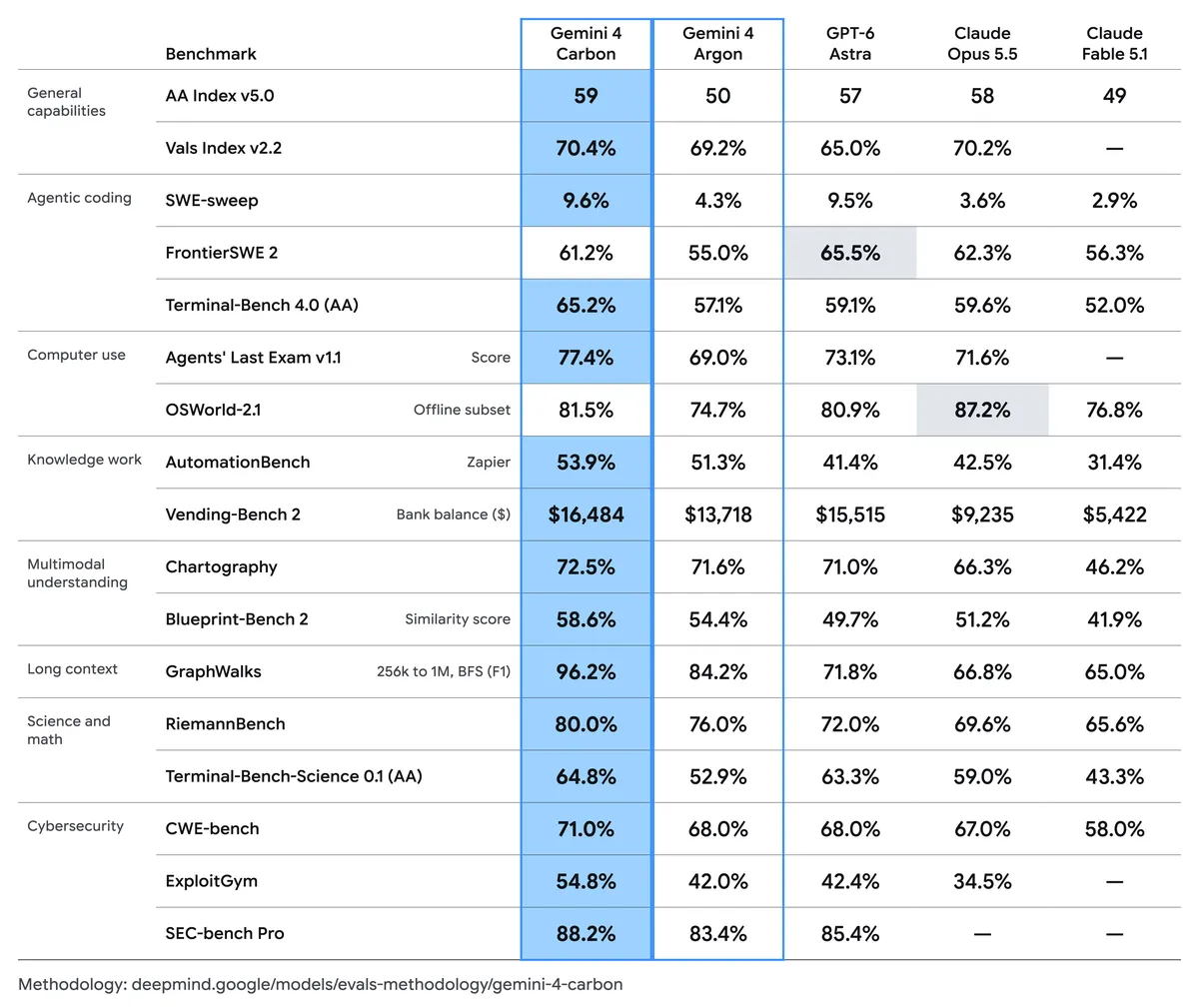
Image: Google DeepMind
Staged rollout and pricing
The model is currently available to a subset of cyber‑defence companies through Google’s Fairwind Program and is being tested under the U.S. government’s voluntary pre‑release framework.
When it does open to developers, the introductory API price will match Argon’s – $2 per million input tokens and $10 per million output tokens, with cached input tokens at 95 % discount.
What this means for creators
For small businesses building web tools or creators developing custom plugins, a model that can spot real vulnerabilities and suggest patched code could cut security audit costs dramatically.
The limited early access means you’ll need to plan for a wait if you rely on the Gemini API.
Sources
This post is based on Google DeepMind, The Verge, Ars Technica.
Want more AI news in plain English? Read the latest on the Zoetra Blog.