Google rolls out fast Gemini 4 Hydrogen model and privacy‑first smart glasses
On 12 November 2026 Google announced Gemini 4 Hydrogen, a speedy new AI model for everyday coding, and also opened pre‑orders for Gemini‑powered smart glasses that promise tighter privacy controls.
Hydrogen delivers speed for developers
Hydrogen is positioned as the “rapid execution” sibling of frontier models Carbon and Argon. It keeps the same 1 million‑token window but costs $1.50 per million input tokens and $7.50 per million output tokens.
In internal benchmarks Hydrogen finished tasks 2.5 times faster than Gemini 3.8 Flash and cut token use by 12‑23 percent on large codebases.
- Runs 2 to 2.8 times faster on complex repository scans
- Reduces fabricated claims more than five‑fold
- Ranks #5 on Agent Arena and leads its class on several specialist benches
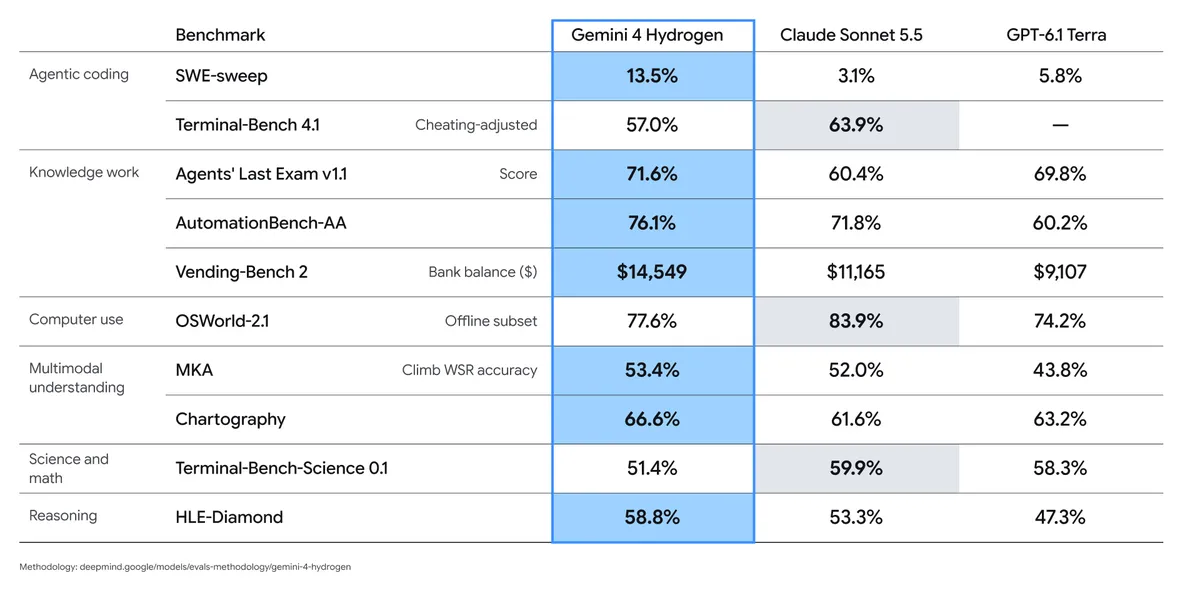
Image: Google DeepMind
Orchestrator lets models share the load
Google’s new Orchestrator in Antigravity automatically switches between Carbon and Hydrogen within a single session. On the Terminal‑Bench 4.0 test it achieved near‑Carbon success while using 24 % less quota and finishing 19 % quicker.
The idea is to let Carbon act as a coordinator while Hydrogen powers worker and verifier agents, so teams can ship complex projects without ballooning token costs.
Gemini‑powered smart glasses hit the market
Gentle Monster and Warby Parker are selling the first Gemini‑enabled glasses today. Prices start at $395 for Warby Parker frames and $449 for Gentle Monster styles, with options for transparent or tinted lenses.
The glasses weigh about 41 grams and include a 12 MP wide‑angle camera, open‑ear speakers and a touch‑sensitive area to invoke Gemini with “Hey Gemini”.
- Physical off‑switch and recording light that blocks camera if covered
- No live‑streaming apps; recorded media stays in your gallery
- Automatic face redaction before video reaches Google

Image: Google DeepMind
Privacy promises and limits
Google says it won’t store captured images or video in your Gemini history, nor use them to train models or target ads. Voice chats can be deleted, but the same protection level isn’t guaranteed.
Data is encrypted in transit but not on Google’s servers yet; the company is working on Private AI Compute to isolate processing.
Why creators should care
If you build apps or generate content, Hydrogen’s speed could shave hours off routine coding and testing, especially when paired with Carbon for deeper reasoning.
The smart glasses offer a hands‑free way to query Gemini on the go, but the privacy safeguards mean you’ll need to weigh convenience against the current limits on data protection.
What’s next for Gemini and wearables
Hydrogen shows how Google is separating speed from deep reasoning, while the new glasses test how far privacy‑focused AI can go in everyday wear.
Sources
This post is based on Google DeepMind, Ars Technica.
Want more AI news in plain English? Read the latest on the Zoetra Blog.