Korea’s factories speed up AI simulations by up to 1,600 times
On 9 November 2026 NVIDIA announced a suite of collaborations that are moving physical AI from research into everyday production in Korea. Samsung, Kakao Mobility and LG Electronics are each tapping GPU‑accelerated tools to cut simulation times dramatically.
Samsung’s chip‑scale speed‑up
Samsung Electronics is expanding its work with NVIDIA on accelerated computing and AI physics across the whole semiconductor design flow. Using NVIDIA cuISS, cuDSS and cuEST, Samsung reports quantum‑chemical calculations running up to five times faster.
The biggest headline is an AI‑driven homogenisation case where a GPU‑accelerated coarse‑grid solve finished in 41 seconds, compared with about 18 hours on a 32‑core CPU – roughly a 1,600× speedup.
- Materials research: sMOL platform with cuEST
- Process and optical simulation: GPU acceleration
- Thermal and mechanical analysis: PhysicsNeMo workflows
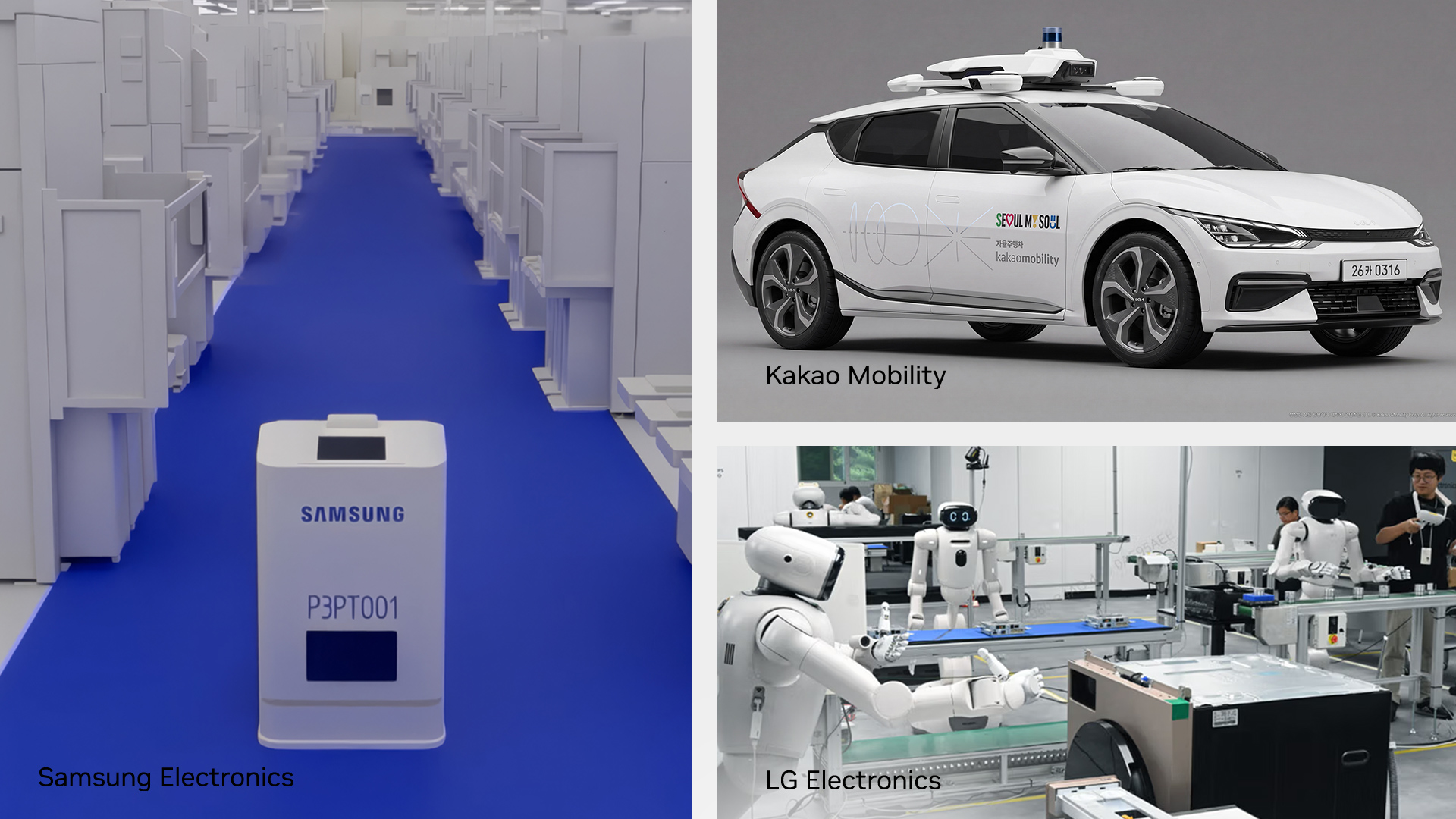
Image: NVIDIA
Kakao Mobility targets level‑4 autonomy
Kakao Mobility is pairing its own driving software with NVIDIA’s vehicle computing stack to build a level‑4 autonomous system. The plan centres on the Hyperion reference platform powered by DRIVE AGX Thor, and on the Halos safety suite.
Initial development will use Kia purpose‑built cars in Seoul’s Gangnam district, aiming to lay the groundwork for future level‑4 mobility services.
LG’s robot learning loop
LG Electronics and NVIDIA demonstrated a full physical‑AI data flywheel with the CLOiD robot in a real factory. Data from the robot feeds into NVIDIA Cosmos for augmentation, then into the GR00T model, and finally runs on Jetson AGX Thor for on‑board inference.
The loop creates reusable workflows that let the team continually train, evaluate and improve robotic manipulation tasks.
Sources
This post is based on NVIDIA.
Want more AI news in plain English? Read the latest on the Zoetra Blog.