NVIDIA’s AI agents turn scans and turbines into editable simulations
On 29 October 2026 NVIDIA showed how its frontier AI models, especially GPT‑6 Astra, are being used inside Omniverse to turn raw data into working simulations. Developers can now give natural‑language prompts and watch a virtual building, gas turbine or warehouse appear and behave in real time.
From panoramic photos to editable building models
David Wehr used Astra to read panoramic site photos, create building geometry and line it up with point‑cloud measurements. The result is an OpenUSD model that can be edited – shelving, machinery or walls can be moved before any physical changes are made.
Because the model lives in Omniverse, the same libraries that power GPU‑accelerated physics and rendering can instantly show how a new layout would look. For a warehouse planner, that means testing automation concepts without ever touching the real floor.
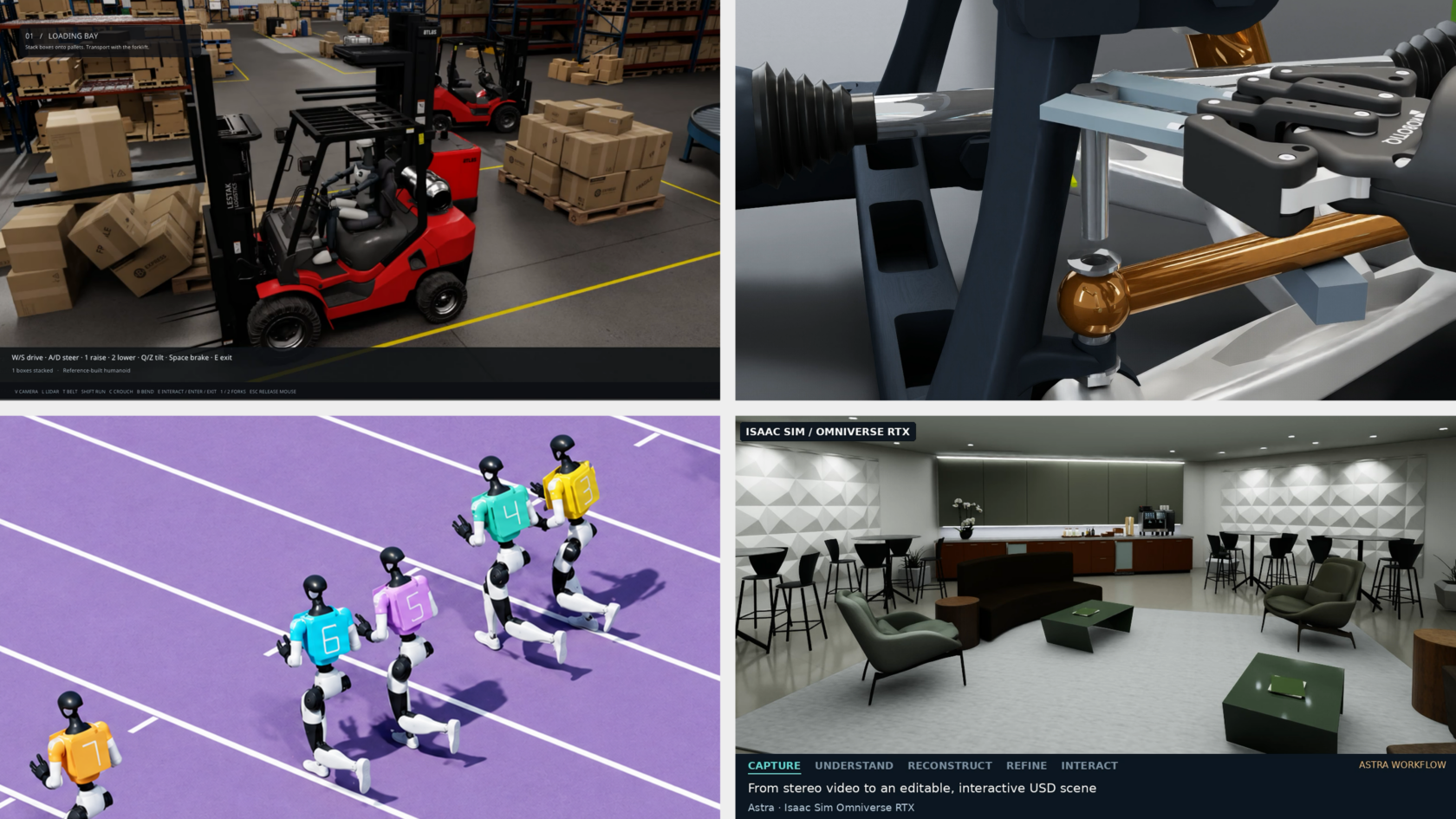
Image: NVIDIA
Digital twin of a gas turbine for what‑if testing
Pradeep Kaushik directed Astra to build a turbine twin where users can tweak load, ambient temperature or fuel composition. The app links thermochemistry tools like Cantera and SciPy to rotor animation and colour‑coded temperature maps.
Engineers can rotate, zoom and scrub through a simulated response while charts update side‑by‑side. Six pre‑written test procedures explore faults such as a stuck fuel valve or an exhaust‑sensor error, giving a quick view of which scenarios merit deeper physical testing.
Scaling up: warehouse stress testing
Bhavik Sanganee pushed a warehouse scene to 80 conveyors, 40 robot arms and 800 boxes. With Astra’s help the simulation kept 30 fps at full HD for two minutes, completing 640 successful box placements.
When the scene doubled again performance fell, and the test pinpointed the physics and robot‑control pipeline as the bottleneck. That insight tells developers where to optimise before adding more robots or packages.
- 30 fps sustained at 1920×1080
- 80 conveyors, 40 arms, 800 boxes
- Performance drop traced to physics pipeline
Robotics, cables and reinforcement learning
Oyindamola Omotuyi asked Astra to simulate a robot threading a flexible USB‑C cable into a port. Using Isaac Lab physics and a Robotiq gripper, Astra built a reinforcement‑learning controller that combined learned movements with real‑time position feedback.
The simulation can now test cable bending and connector alignment before any hardware is built. The next step, according to the source, is to add friction‑held grasps and feed camera data from a physical robot back into the loop.
Building scenes with SimReady assets
Paul Kind demonstrated how an AI agent can pull from the SimReady Central Library – more than 2,000 USD assets with embedded simulation properties – and assemble a kitchen scene in conversation.
The workflow shows that developers don’t need to model every object from scratch; they can pick ready‑made, simulation‑ready pieces, place them via chat and then fine‑tune the render with Isaac Sim.
Sources
This post is based on NVIDIA.
Want more AI news in plain English? Read the latest on the Zoetra Blog.